











$109.99
SKU:
ICMDS3524Availability:
In Stock - Broadmeadow
Quantity:
 Ships in 24 - 48 hoursFlat Rate $9.95 Shipping To Metro Areas*Free Shipping For Orders Over $150 To Metro Areas* (Online orders only)
Pz.Kpfw. V Panther Ausf. D The Pz.Kpfw. V Panther Ausf.
Description
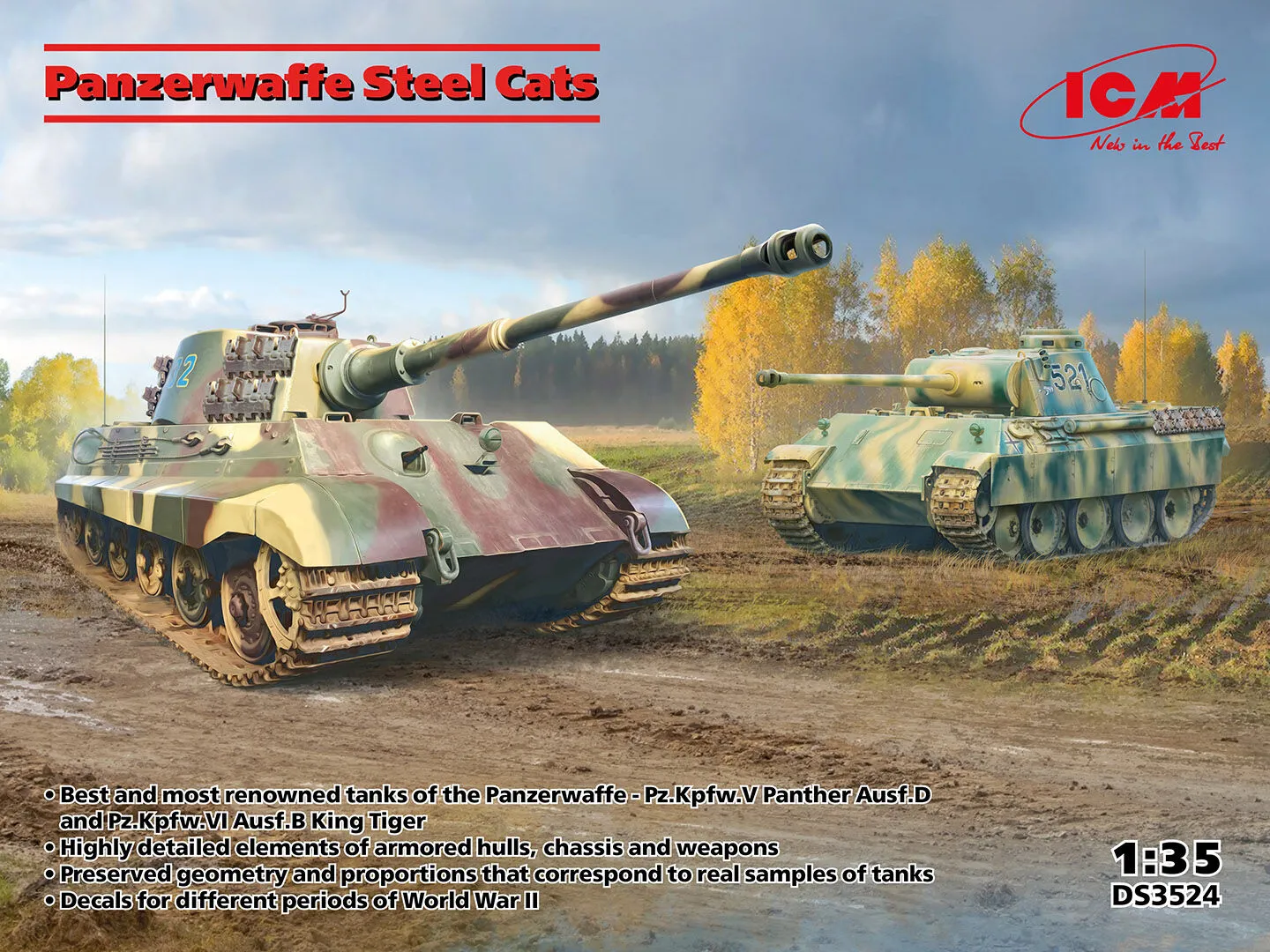
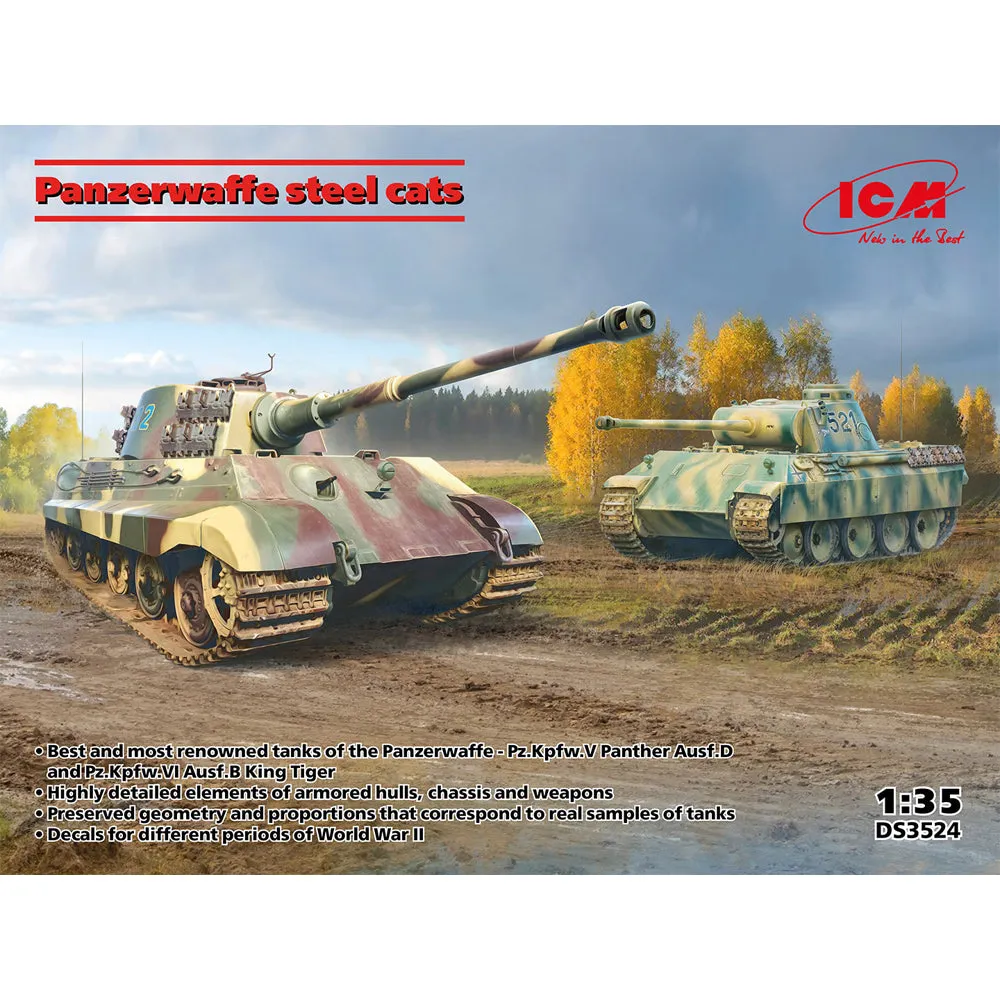
Before the start of World War II, the tank forces of the Third Reich (Panzerwaffe) were mainly equipped with light and medium tanks. The results of battles on the Eastern Front in 1941 showed that to successfully counter Soviet tanks, new types of armored vehicles with powerful guns and thick armor were needed. At the beginning of 1943, production of the Pz.Kpfw V Panther tank with a 75-mm long-barreled 7.5 cm KwK42 L/70 gun began. The weight of this tank, depending on the modification, ranged from 43 to 45.5 tons. This tank was classified as both medium and heavy based on various criteria. Many military historians consider it one of the best tanks of World War II. The Pz.Kpfw V also served as the basis for the Jagdpanther tank destroyer and the Bergepanther recovery vehicle. In the winter of 1944, production of another tank, the Pz.Kpfw VI Ausf B Konigstiger, developed by Henschel under the leadership of E. Aders, began. This tank had heavy armor and a long-barreled 88-mm gun. Its armor-piercing shell was capable of hitting any Allied tank at a distance of 2000 meters or more. The Pz.Kpfw.VI Ausf.B tanks served in heavy tank battalions until the end of the war, with a total of 479 Königstiger produced between 1944 and 1945.
Pz.Kpfw. V Panther Ausf. D The Pz.Kpfw. V Panther Ausf. D, commonly known simply as the Panther, was a German medium tank introduced during World War II, renowned for its powerful combination of firepower, protection, and mobility.
The Ausf. D was the first production variant of the Panther, entering service in 1943.
The Panther was designed to counter the Soviet T-34, and it incorporated several advanced features.
It was equipped with a long-barreled 7.5 cm KwK 42 L/70 gun, which was highly effective against most Allied armor at long ranges.
The gun's high muzzle velocity allowed it to penetrate enemy tanks with ease, making the Panther one of the most feared tanks on the battlefield.
In terms of armor, the Panther Ausf. D featured sloped frontal armor up to 80 mm thick, which significantly improved its ability to deflect incoming shots.
However, the side armor was thinner, making it vulnerable to flanking attacks.
The Ausf. D variant also had a distinctive "letterbox" hull machine gun port, which was later changed in subsequent versions.
The Panther was powered by a Maybach HL230 P30 V12 engine, delivering 690 horsepower, allowing it to reach speeds of up to 34 mph (55 km/h) on roads.
This combination of speed and armor made it highly maneuverable for its size, giving it an edge in both offensive and defensive operations.
However, the Panther Ausf. D suffered from several mechanical issues, particularly with its final drive and suspension system, which were prone to breakdowns.
These teething problems were partly due to the rushed production and the complexity of its design.
Despite these issues, the Panther Ausf. D proved to be a formidable opponent on the battlefield and laid the groundwork for subsequent, more refined versions.
Pz.Kpfw. VI Ausf. B King Tiger The Pz.Kpfw. VI Ausf. B, more commonly known as the King Tiger or Tiger II, was a German heavy tank introduced in 1944, representing the pinnacle of German armored warfare during World War II.
The King Tiger combined the thickest armor and the most powerful gun mounted on a German tank, making it one of the most feared vehicles of the war.
The King Tiger was armed with the 8.8 cm KwK 43 L/71 gun, an incredibly powerful weapon capable of destroying any Allied tank at extreme ranges.
The gun's accuracy and penetrating power were unmatched, allowing the King Tiger to engage and destroy enemy tanks before they could effectively return fire.
One of the defining features of the King Tiger was its massive armor.
The front glacis plate was 150 mm thick and sloped, providing exceptional protection against all but the most powerful Allied anti-tank weapons.
The turret front was even thicker, at 180 mm, making the King Tiger nearly impervious to frontal attacks.
However, this heavy armor came at a cost.
The tank weighed around 68 tons, which made it slow and less maneuverable than lighter tanks, and it was prone to mechanical breakdowns due to the immense strain on its components.
The King Tiger wa
| Plastic Kits | Land |
| PLASTIC MODELS | TANKS |
| SKU | ICMDS3524 |
| Manufacturer | ICM |
| EAN | Does Not Apply |
| Short Description | ICM 1/35 Panzerwaffe Steel Cats Pz.Kpfw.V Panther Ausf.D, Pz.Kpfw.VI Ausf.B King Tiger # DS3524 |
Specifications
| Brand | ICM |
![AFV Club 1/35 Churchill Mk.VI Plastic Model Kit [AF35S52]](/assets/thumb/AFV-35S52.webp?20260406111901)
![AFV Club 1/35 German M88A1G Bergepanzer M88A1G Recovery Tank Plastic Model Kit [AF35S33]](/assets/thumb/AFV-35S33.webp?20260406111856)



Return guarantee

On every order

Products available



Add your favourites to cart

Select Afterpay at checkout

Log into or create your Afterpay account, with instant approval decision
Your purchase will be split into 4 payments, payable every 2 weeks
All you need to apply is to have a debit or credit card, to be over 18 years of age, and to be a resident of country offering Afterpay
Late fees and additional eligibility criteria apply. The first payment may be due at the time of purchase
For complete terms visit afterpay.com/terms